
Florida developers face a challenge that does not get enough attention: methane gas in the soil. From former landfills to naturally occurring organic deposits, methane can be present under construction sites across the state. If you are building in Florida, understanding methane mitigation could save you from a serious safety hazard and a regulatory headache.
Why Methane Is a Problem in Florida
Florida has thousands of former landfills and dumping sites. Many of these are now being redeveloped for commercial and residential use. As organic waste decomposes underground, it produces methane. Methane is explosive at concentrations between 5 and 15 percent in air. It can migrate through sandy Florida soils and accumulate under slabs or in enclosed spaces like parking garages and basements.
Beyond landfills, Florida’s geology includes areas with naturally occurring methane from decomposing organic matter in wetlands and limestone formations. Any site with a history of organic material in the soil has the potential for methane. This includes many areas near Orlando, Tampa, Miami, and along the coast.
Florida’s high water table also plays a role. Water acts as a cap that traps methane in the soil. When the water table drops during dry periods, trapped methane can be released and migrate toward the surface and into buildings.
Building Code Requirements
Florida building codes address methane mitigation in areas known to have landfill gas or subsurface methane. Local codes may require gas monitoring during construction and ongoing monitoring after occupancy. The requirements typically include a gas-proof membrane under the slab, a venting layer to channel methane to extraction points, and active extraction fans in high risk areas.
The Florida Department of Environmental Protection provides guidelines for methane assessment and mitigation on former landfill sites. Developers should check with local building departments early in the planning process to understand what will be required.
Methane Mitigation Systems
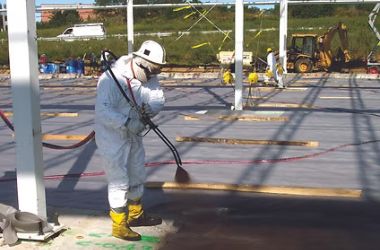
A complete methane mitigation system has three parts. A gas vapor barrier installed under the slab that blocks methane from entering the building. This barrier needs to be thicker and more puncture resistant than standard vapor barriers. A venting layer of crushed stone or geocomposite that allows methane to flow freely to extraction points. And an active extraction system with explosion proof fans that pull methane from beneath the slab and vent it safely above the roofline.
CETCO GeoVent is one of the most popular systems for Florida methane mitigation. GeoVent combines a gas barrier with an integrated geocomposite venting layer in a single product. This simplifies installation and reduces the risk of errors. GeoVent works for both methane and VOC intrusion and is used extensively in Florida landfill redevelopment projects.
EAI-South in Florida
We serve Florida from our Fernandina Beach office. We install methane mitigation systems, CETCO GeoVent, and gas vapor barriers for commercial and industrial projects throughout the state. Our team understands Florida’s unique conditions and regulatory environment. If you are dealing with methane concerns on a Florida site, we can help with system design, installation, and verification testing.
We also handle vapor intrusion mitigation, waterproofing, and soil vapor testing across the Southeast. Give us a call to talk about your project.