
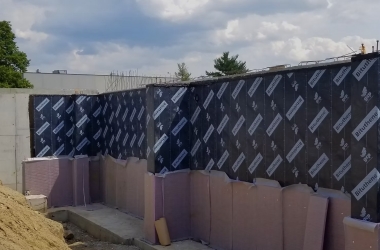
Waterproofing a below-grade structure in Florida is not the same as doing it in New Jersey or New York. The conditions are fundamentally different. High water tables, sandy soils, saltwater intrusion, and seasonal storms all create challenges that need specific solutions.
If you are building below grade in Florida, here is what you need to know about keeping water out.
The Florida Water Table Problem
Much of Florida has a water table within a few feet of the surface. In coastal areas like Fernandina Beach, Jacksonville, and Miami, the water table can be at or near the ground surface during the wet season from June through October. This puts constant hydrostatic pressure on below grade walls and slabs. Any weakness in the waterproofing system will result in water intrusion.
The sandy soils common throughout Florida drain quickly, which sounds good until you realize that water moves through sand fast. A heavy afternoon thunderstorm can send a surge of water against your foundation walls within minutes. If the waterproofing has a gap or a thin spot, that surge will find it.
Saltwater intrusion is another concern in coastal areas. Saltwater is more corrosive than freshwater and can degrade some waterproofing materials over time. If your site is near the coast, your waterproofing system needs to be salt resistant.
Waterproofing Systems That Work in Florida
Bentonite panels. Volclay and similar sodium bentonite panels are a strong choice for Florida conditions. Bentonite is a natural clay that expands when it contacts water. It swells to many times its dry volume, creating a self-sealing gel that blocks further water intrusion. Bentonite is especially effective in Florida because it performs well in the constant moisture environment. It also self-heals small cracks that develop over time, which is important in Florida’s shifting sandy soils.
Fluid-applied membranes. Liquid applied coatings like CETCO Liquid Boot create a seamless bonded barrier on concrete surfaces. Because they bond directly to the concrete, there are no seams to fail. Fluid-applied systems work well for irregular surfaces and repairs where sheet membranes are hard to install properly.
Sheet membranes. Traditional sheet membranes from Soprema and Aquafin are still widely used in Florida. They require careful seam sealing and protection during backfilling. In Florida’s high moisture environment, sheet membranes should be paired with drainage boards that direct water to the foundation drainage system.
Cementitious waterproofing. For interior applications like elevator pits and utility tunnels, cementitious coatings provide a cost effective solution. They bond directly to concrete and can handle positive hydrostatic pressure. They are less flexible than membrane systems, so they work best on stable substrates.
Working With a Florida Contractor
Florida’s unique conditions mean you want a contractor who has experience with local soils, water tables, and building codes. A contractor who learned waterproofing in a northern climate may not understand Florida’s specific challenges.
EAI-South serves Florida from our Fernandina Beach office. We install bentonite panels, fluid-applied membranes, and sheet membrane systems throughout the state. Our team is certified on CETCO, Soprema, and Aquafin systems and understands Florida’s environment. We cover the whole state from the Panhandle down to Miami.