
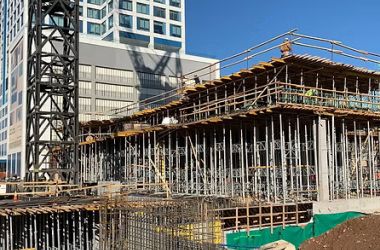
Jersey City has been through one of the biggest redevelopment booms on the East Coast. Old industrial sites, warehouses, and rail yards are being turned into apartments, offices, and retail spaces. But building on former industrial land comes with a catch: you need to test the soil vapor first.
This guide walks through what soil vapor testing involves, why it matters in Jersey City, and how to get it done.
Why Soil Vapor Testing Matters in Jersey City
Jersey City’s industrial past left behind contaminants in the soil and groundwater. For decades, factories, dry cleaners, gas stations, and rail yards operated throughout the city. Many of these operations used or produced chemicals that are now known to be hazardous. Common contaminants include chlorinated solvents like PCE from dry cleaning, petroleum hydrocarbons from gas stations and storage tanks, and heavy metals from industrial processes.
These contaminants produce vapors that can migrate up through the soil and into buildings. If you are planning to build on or near a former industrial site, you need to know what is in the soil vapor before you pour your foundation. NJDEP requires soil vapor testing at many Jersey City redevelopment sites, especially in areas like the waterfront, Journal Square, and the Greenville section where industrial use was heaviest.
The Soil Vapor Testing Process
Soil vapor testing follows a standard process that has been used on hundreds of sites in Jersey City.
Step 1: Site Assessment. A licensed environmental professional reviews the site history. They look at what used to be on the property, what was on neighboring properties, and what contaminants are likely to be present. This determines where to place the sampling points.
Step 2: Probe Installation. Temporary or permanent soil gas probes are installed at the selected locations. A small diameter probe is driven into the soil to the target depth, typically 5 to 15 feet below the surface. The probe is sealed at the surface to prevent outside air from contaminating the sample.
Step 3: Sampling. A vacuum pump pulls soil gas from the probe through a tube and into a sample container. The most common container is a summa canister, which is a pre evacuated stainless steel container that collects a sample over a set period. The sampling duration depends on the site conditions and the target contaminants.
Step 4: Laboratory Analysis. The samples go to a certified laboratory where they are analyzed for VOCs, petroleum hydrocarbons, methane, and other target chemicals. The lab uses methods specified by the EPA and NJDEP. Results are compared to NJDEP screening levels to determine if mitigation is needed.
Step 5: Reporting. A report is prepared showing the results, comparing them to regulatory standards, and recommending next steps. If soil vapor levels exceed NJDEP screening levels, vapor mitigation is typically required. The report also includes the laboratory data sheets and chain of custody documentation.
Common Contaminants Found in Jersey City
The most common contaminants found in Jersey City soil vapor tests are PCE and TCE from former dry cleaners, petroleum hydrocarbons from gas stations and storage tanks, and BTEX compounds from industrial operations. Each of these requires a different mitigation approach, so knowing exactly what is present is critical.
How EAI-South Can Help
EAI-South has been working in Jersey City for years. Our office is at 50 Prescott Street in Jersey City. We handle soil vapor testing, vapor intrusion mitigation, and environmental site assessments throughout Hudson County. If your soil vapor test comes back showing levels above NJDEP screening levels, we can design and install the mitigation system. One team from testing through mitigation means fewer coordination headaches for you.